
Woodworking Knife
- HSS · TCTM2 and cobalt high-speed
steel, tungsten carbide - ±0.02 mmThickness tolerance,
flatness ≤0.05 mm - DW733 / 734 / 735Direct-fit planer knives
and other mainstream heads - Custom to DrawingWidth, thickness, bevel
angle and slot pattern
We manufacture a full range of woodworking knives — thicknesser and planer knives, jointer knives, electric planer blades and veneer peeling knives — for professional timber processing, joinery and workshop use. The knives are made in HSS M2 and cobalt M35 high-speed steel or in tungsten carbide (TCT), and are produced as direct-fit replacements for the mainstream planer heads, including DeWalt DW733, DW734 and DW735 / DW735X (DW7332, DW7342 and DW7352 cross-references) as well as the equivalent Makita, Bosch, Ryobi and Craftsman machines.
Width, thickness, bevel angle, slot pattern and locating notches are ground to your drawing, so every knife in the head projects to the same height and the board comes off flat — no ripple across the width, no crown along the length, no snipe at the ends. Custom sizes, sections and edge preparations are supported for different cutter heads, timber species and board products, from a single replacement set for a bench top planer to knives for a four-sided moulder.
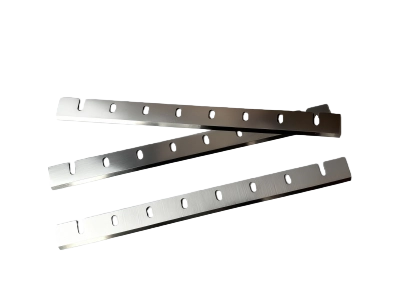
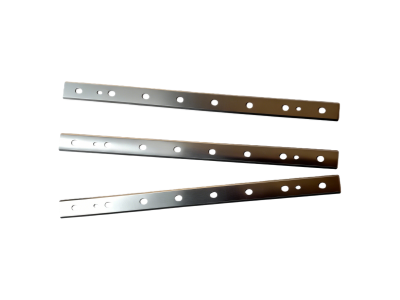
- Replacement knives for the planers you already run — DW733 (12-1/2" × 1-1/16" × 1/8", DW7332 cross-reference), DW734 (12-1/2" × 7/8" × 1/16", DW7342) and DW735 / DW735X (13" × 7/8" × 1/16", DW7352), plus the equivalent Makita, Bosch, Ryobi and Craftsman planer blades
- Material chosen for the stock you plane — HSS M2 for general softwood and hardwood, cobalt M35 for abrasive MDF and reclaimed timber, TCT (carbide) for board and panel production where a knife change stops the line
- Geometry ground to your cutter head — width, thickness, bevel angle, slots and locating notches cut to your drawing or to the knife you are replacing, so the blade seats on the jack screws and projects to the same height as its neighbours
- Matched sets, inspected per batch — thickness and hardness held within the batch and reported, with a 100% edge check, so a new knife never leaves a ripple or a crown in the board
Woodworking Knives We Manufacture

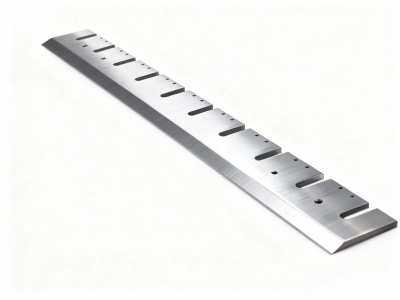
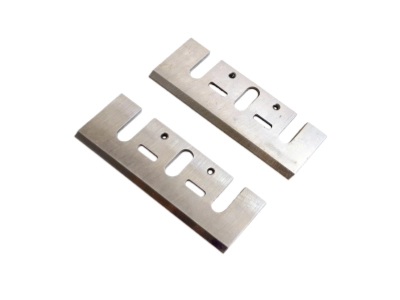
For DW73312-1/2" × 1-1/16" × 1/8" — two-knife head, DW7332 cross-reference For DW734 / DW73512.5" × 7/8" × 1/16" and 13" × 7/8" × 1/16" — three-knife heads Veneer Peeling BladeLong knives for veneer lathes and slicers — custom size available Electric Planer Blade82 × 29 × 3 mm — handheld planer knives, reversible
Choosing the Steel: HSS M2, M35, T1 or TCT
| Grade | Hardness | Edge life | Best for | What it gives you |
|---|---|---|---|---|
| HSS M2 / W6Mo5Cr4V2 (SKH51) | HRC 62–65 | Good | General planing and jointing of softwood and hardwood — the standard replacement knife | The reference planer steel: roughly 6% tungsten, 5% molybdenum and 4% chromium give the hot hardness a 10,000–20,000 rpm cutter head needs, and it hones and regrinds predictably. |
| HSS M35 / W6Mo5Cr4V2Co5 (SKH55) | HRC 64–67 | Very good | Abrasive stock — MDF, HDF, particleboard, reclaimed timber with grit and staples | Cobalt raises the red hardness. Where silica in board products or dirt in reclaimed timber would blunt M2 inside a shift, M35 keeps cutting without softening. |
| HSS T1 / W18Cr4V (18-4-1) | HRC 63–66 | Very good | High-speed heads and dense hardwoods such as ipe, teak and wenge | The highest hot hardness of the high-speed steels. Harder to grind and less forgiving of shock than M2, but it holds its edge where M2 would start to give way. |
| TCT / carbide YG6X | HRA 90–92 | Excellent | Board and MDF production, high-volume planing and moulding | Cemented carbide holds an edge several times longer than any HSS grade and is unaffected by the heat of continuous cutting. It tolerates less impact, so it suits a stable, well-clamped head. |
| TCT / carbide YG8 | HRA 88–90 | Excellent | Mixed feed stock on older heads where some impact is present | The tougher carbide grade. A little less wear resistance than YG6X in exchange for noticeably more resistance to chipping when the stock is not perfectly clean. |
| 6CrW2Si | HRC 54–57 | Moderate | Veneer, chipper and flaker knives that take impact | Shock-resistant rather than wear-resistant, and the conventional choice for veneer lathe and chipper knives, where a harder edge would chip the moment it meets a knot. |
| 65Mn / spring steel | HRC 45–52 | Basic | Light-duty knives, shredder and garden chipper blades | Tough, inexpensive and easy to sharpen. It will not hold an edge like HSS, so it is specified where first cost matters more than blade life. |
Not sure which grade fits your machine and your timber? Tell us the planer model, the board or species you run and how often the knives are changed — our engineers will recommend the steel, hardness and bevel angle that gives the lowest cost per cubic metre planed.
Woodworking Knife Specifications
| Specification | Standard range | Notes |
|---|---|---|
| Material grade | HSS M2 / W6Mo5Cr4V2 (SKH51) · HSS M35 / SKH55 · HSS T1 / W18Cr4V · TCT carbide YG6X and YG8 · 6CrW2Si · 65Mn | Grade selected from the machine, the timber or board, and how often the knives are changed |
| Hardness | HSS HRC 62–67 · TCT (carbide) HRA 88–92 | Vacuum hardening and multiple tempering; hardness reported per batch |
| Blade types | Thicknesser and planer knives · jointer knives · electric planer blades · veneer peeling and slicer knives · chipper and flaker knives · moulding and spindle knives | Every profile ground to your drawing or to the knife you are replacing |
| DeWalt planer fitments | DW733 12-1/2" × 1-1/16" × 1/8" (DW7332) · DW734 12-1/2" × 7/8" × 1/16" (DW7342) · DW735 / DW735X 13" × 7/8" × 1/16" (DW7352) | Supplied as matched sets — two knives for DW733, three for DW734 / DW735 |
| Electric planer blade | 82 × 29 × 3 mm | Handheld planer category; equivalent sizes for Makita, Bosch, Ryobi and Craftsman |
| Veneer peeling knives | Length up to 3000 mm · thickness 12–25 mm | Edge straightness and bevel controlled along the whole length, because it transfers directly into veneer thickness variation |
| Thickness | 1.5–25 mm depending on the blade type | Replacement planer knives 1.6 mm and 3.2 mm as standard; heavier sections for chipper and veneer knives |
| Thickness tolerance | ±0.02 mm on ground knives | The knife's projection in the head depends on it — and projection is what decides whether the board comes out flat |
| Flatness & parallelism | ≤0.05 mm | Checked on a granite surface plate before dispatch |
| Straightness | ≤0.1 mm over the full length | Prevents a crown or a low spot running the length of every board |
| Bevel angle | 30°–45° included as standard; 18°–21° for veneer knives | Shallower for soft timber and veneer, steeper for dense hardwoods and impact duty |
| Edge preparation | Ground and honed, with a micro-bevel available | A honed edge cuts cleanly from the first pass and resists chipping on knots and grit |
| Slots & mounting | Slot pattern, locating notches, pin holes and counterbores to your drawing | Cut so the knife seats on the jack screws and the gib bars clamp it evenly |
| Packing | Edge-protected, sealed export case | Blades wrapped individually and supplied in matched sets ready for fitting |
Values above are our standard production range. Send the planer model and a drawing — or a photo of the knife you are replacing with a ruler across it — and we will confirm the exact specification before quoting.
Typical Woodworking Applications
Planing and Surface Finishing
Bench top thicknessers, jointers and electric planers, where an even surface and a true edge are what the finished piece is judged on.
- Replacement knives for DeWalt DW733, DW734 and DW735 / DW735X heads
- Jointer and surface planer knives with a matched bevel for clean grain
- 82 mm handheld electric planer blades, reversible, in HSS or TCT
Solid Wood and Hardwood Machining
Dense and abrasive timbers and reclaimed stock wear an edge far faster than softwood. Grade and bevel are set to the species, not to the machine alone.
- High-speed and cobalt HSS for hard, dense species such as ipe, teak and wenge
- TCT knives for continuous runs on furniture and joinery stock
- Micro-bevel edge option for timber carrying grit, staples or old finish
Veneer Peeling and Panel Production
Long knives that peel a log into a continuous sheet, plus the board and panel grades where blade changes are the bottleneck in the shift.
- Veneer peeling and slicer knives in 6CrW2Si up to 3000 mm long
- 18°–21° bevel with straightness held over the full length
- TCT grades for MDF, HDF, particleboard and plywood planing and moulding
Industrial and Workshop Machines
From a single benchtop planer in a workshop to a four-sided moulder in a mill, the knife has to fit the head and match the rest of the set.
- Moulders, four-sided planers and spindle heads to drawing
- Chip for chippers, flakers and shredder blades in shock-resistant grades
- Cross-reference patterns for the mainstream Makita, Bosch, Ryobi and Craftsman machines
Machining a timber or running a machine head that is not listed? Send us the drawing, the species and your current knife — our engineers will specify the steel, hardness and bevel angle to match.
Why Source Woodworking Knives from DEKEER
01 — Factory Direct
Manufacturer, not a trading companyDekeer Precision Cutting Tools (Nanjing) forges, vacuum heat treats and CNC grinds every woodworking knife in-house — from bar stock to the finished, honed edge.
02 — Precision Grinding
Thickness ±0.02 mm, flatness ≤0.05 mmKnives are ground in matched sets and checked on a granite plate. All knives in a head must project to the same height within a few hundredths of a millimetre — a single knife set high is what leaves a ripple across the board.
03 — Documented Quality
Hardness, dimension and material reportsEach batch ships with a hardness report, a dimensional inspection of thickness, width, slot position and straightness, a bevel-angle check, a 100% edge inspection, and a material certificate on request.
04 — After-Sales
12-month warranty and regrind support12-month coverage against manufacturing defects, plus engineering advice on grade selection, bevel angle, knife setting and torque sequence, feed rate, and when to rotate a reversible knife or replace the set.
How a woodworking knife order works, from inquiry to delivery
- 1Send your specPlaner model, drawing or a used knife
- 2Quote in 24 hSteel grade, hardness, bevel and slots confirmed
- 3Drawing confirmationYou approve the final specification
- 4ProductionCutting, vacuum hardening, CNC grinding and honing
- 5Final inspectionHardness, thickness, flatness, straightness, edge test
- 6Export packingEdge-protected sealed cases, matched sets, worldwide shipping
Frequently Asked Questions About Woodworking Knives
Which blades fit my DeWalt DW733, DW734 or DW735 planer?
Should I choose HSS or TCT for a planer knife?
What causes a wavy or rippled surface when planing?
Are your knives supplied as matched sets?
Can you supply blades for machines other than DeWalt?
How tight are the tolerances on a woodworking knife?
What is the veneer peeling blade, and what do you hold on it?
How should the knives be set and maintained?
Can the knives be resharpened, and how many times?
What do you need to quote, and what is the lead time?
Related Products and Guides
-
Tungsten Carbide Blades
Vacuum-sintered YG-series carbide blades for the most abrasive cutting duty — many times the edge life of an HSS knife.
View series → -
Packaging Machine Blades
Cross-cutting and longitudinal blades for form-fill-seal, flow-wrap and pouch making equipment.
View series → -
HSS Paper Cutter Blades
Guillotine and trimmer blades in HSS for Polar, Wohlenberg, Perfecta, Ideal, Itoh, Schneider and Maxima.
View series → -
Serrated Industrial Knives
Heat-seal and cutting serrated blades for packaging machinery, custom-made to drawing in four material grades.
View series → -
Longitudinal Shear Circular Blades
Precision slitting knives for metal coil lines, held to ±0.003 mm thickness with bores cut to your shaft drawing.
View series → -
Doctor Blades
Precision metering blades for gravure and flexo printing, in carbon steel, LongLife ceramic and stainless series.
View series →
Talk to a woodworking blade engineer
Send the planer make and model, the timber or board you machine, or a photo of the knife you are replacing with a ruler across it. Our engineering team will confirm the right steel, hardness, bevel angle, slot pattern and set quantity within 24 hours — free of charge and with no obligation.
- Emaildkeblade@163.com
- WhatsApp+86 138 5558 8148
- Reply within24 hours, Mon–Sat