
Custom Precision Packaging Machine Blades | DEKEER Industrial Cutting Solutions
- HRC 56–65HSS, stainless & D2,
heat treated in-house - ±0.02 mmCNC ground
tolerance - Razor EdgeBurr-free shear cut,
high wear resistance - OEM / ODMLength, thickness
& hole pattern to drawing
Dekeer’s Sealing and Cutting Machine Blades are designed for high-speed shearing, cross-cutting, and longitudinal cutting. With razor-sharp edges, superior wear resistance, and excellent straightness, these industrial blades ensure smooth, precise, and efficient cutting across a wide range of applications. They are widely used in plastic film, non-woven fabrics, pressure-sensitive adhesive (PSA) materials, laminates, and paper products. Dekeer supplies every packing machine blade type — cutter blades, sealing jaws, toothed shear knives and multi-hole cutter bars — to OEMs and converters worldwide.
- High-speed shearing, cross-cutting and longitudinal cutting — built for continuous packaging lines, not intermittent use
- Razor-sharp edge with excellent straightness for a clean, flat, burr-free cut on film, non-woven, PSA and laminates
- Selected grades — HSS, stainless steel or D2 — matched to the material you cut and the machine you run
- Made to your drawing, sample or machine model, including thickness, bevel angle and hole pattern
Packaging Machine Blades in Every Shape and Size

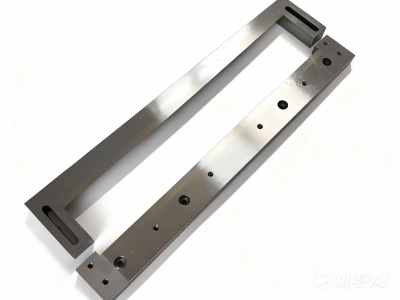
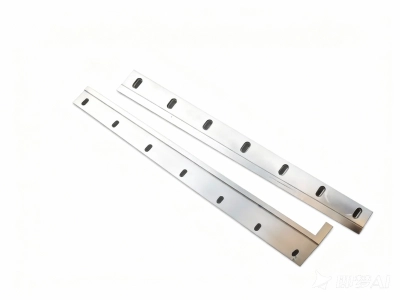
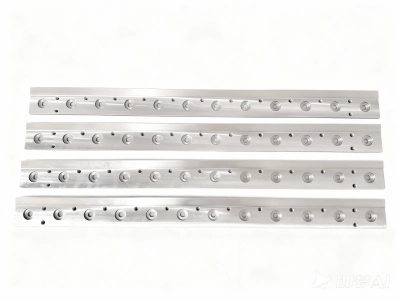
Frame-type packaging machine blade with mounting holes Bevel-ground shear blade pair with fixing holes Multi-hole cutter bars, straightness-ground
HSS vs Stainless Steel vs D2: Choosing the Right Grade
| Selection Factor | HSS (High Speed Steel) | Stainless Steel | D2 Tool Steel |
|---|---|---|---|
| Hardness | HRC 60–65 | HRC 52–57 | HRC 58–62 |
| Wear resistance | High — holds an edge on abrasive film and laminates | Moderate — chosen for hygiene rather than abrasion | Very high — excellent on hard, abrasive webs |
| Toughness | Good — resists chipping under shear shock | High — ductile and forgiving | Moderate — harder, so less shock-tolerant |
| Corrosion resistance | Low — keep oiled when stored | Excellent — rust-free in damp or washed-down areas | Low — requires protection |
| Edge retention | Long service life between regrinds | Shorter on abrasive stock, but easily reground | Longest between regrinds on hard material |
| Typical use | Film, non-woven, PSA, laminate and paper slitting | Food packaging, wet lines, medical and clean areas | Heavy-duty cross-cutting and high-abrasion lines |
| Relative cost | Standard | Standard | Higher |
Not sure which grade suits your line? Tell us the material you cut (film, non-woven, PSA, laminate, paper), the web width, the cutting speed and whether the blade is washed down — our engineers will recommend the grade and bevel that gives the best cost per cut.
Packaging Machine Blade Specifications
| Specification | Standard Range | Notes |
|---|---|---|
| Material grade | HSS (M2 / M35) · Stainless steel (420 / 440C) · D2 | HSS as standard; stainless for food and wash-down areas; D2 for heavy abrasion |
| Hardness | HRC 56–65 | Vacuum hardening and tempering, reported per batch |
| Dimensional tolerance | ±0.02 mm | Ground on CNC surface and profile grinders |
| Straightness | ≤0.10 mm per 1000 mm | Checked on a granite surface plate before dispatch |
| Bevel / edge angle | Single bevel 20–30° as standard | Double bevel, micro-bevel and serrated edge available on request |
| Surface roughness | Ra ≤ 0.4 µm on the cutting face | Polished to reduce friction and material build-up |
| Thickness | 0.2–12 mm | Matched to your cutting head, holder and material |
| Length / width | Made to drawing | From a few millimetres for slitting blades to long cross-cut bars |
| Hole pattern | To drawing or original blade | Bolt holes, slots and counterbores reproduced exactly |
| Finish options | Polished, ground or serrated | Edge protection applied to every finished blade |
Values above are our standard production range. Send the machine model, an original drawing or a photo of the blade you are replacing and we will confirm the exact specification before quoting.
Typical Applications
Pouch & Bag Making
Pouch packing machine cutter blades and sealing blades that keep pouch, sachet and bag lines running at full speed, giving a clean shear on every cycle.
- Pouch and sachet making machines
- Non-woven and plastic bag lines
- Packing machine cutter blade replacements
Packaging Lines
Replacement packing machine cutting blades for horizontal and vertical form-fill-seal equipment, engineered for continuous production.
- Form-fill-seal and flow wrap machines
- Cross-cutting and longitudinal cutting stations
- Film, laminate and foil webs
Food & Hygiene Lines
Stainless steel blades that hold their edge in food packaging, where rust-free performance and easy cleaning matter as much as sharpness.
- Food wrapping and sealing equipment
- Wash-down and damp production areas
- Corrosion-resistant stainless grades
Industrial Cross-Cutting
Durable, high-performance blades for mechanical cross-cutting and general converting duties on film, paper and composite materials.
- Mechanical cross-cutting units
- Paper, board and tissue converting
- Non-woven, PSA and laminate webs
Cutting a different material or running a special machine? Send us the material, the web width and the machine model — we produce packaging machine blades to match almost any cutting station.
Why Source Packaging Machine Blades from DEKEER
01 — Factory Direct
Manufacturer, not a trading companyDekeer Precision Cutting Tools (Nanjing) forges, heat treats and CNC grinds every packaging machine blade in-house — from raw steel bar to the finished polished edge.
02 — Custom Grinding
Size, thickness and hole pattern to your specSend a drawing, a used blade or just the machine model. We reproduce the fixing holes exactly and match the bevel angle to your cutting head and material.
03 — Documented Quality
Hardness and dimensional report with every batchEach shipment carries an HRC hardness report, a dimensional inspection of length, width, thickness and straightness, and a 100% pre-shipment edge test.
04 — After-Sales
12-month warranty and regrind support12-month coverage against manufacturing defects, plus engineering guidance on grade selection, bevel angle and regrind intervals for your packaging line.
How a packaging machine blade order works, from inquiry to delivery
- 1Send your specMachine model, drawing or a used blade
- 2Quote in 24 hMaterial, size and bevel confirmed
- 3Drawing confirmationYou approve the final specification
- 4ProductionForging, heat treatment, CNC grinding
- 5Final inspectionHRC, dimensions, straightness, edge test
- 6Export packingEdge-protected sealed packs, worldwide shipping
Frequently Asked Questions About Packaging Machine Blades
What are DEKEER packaging machine blades used for?
Do you supply packing machine blades for all machine types?
Which material should I choose — HSS, stainless steel or D2?
Can you make blades to match my machine?
What is the sharpening angle of your slicing and cutting blades?
What tolerance do you hold on thickness and straightness?
Do you provide free samples for testing?
What information do I need to send for a quote?
How long is the service life compared with an ordinary steel blade?
Can the blades be resharpened?
What is the usual lead time, and how do you ship?
Related Products and Guides
-
Serrated Industrial Knives
Heat-seal and cutting serrated blades for packaging machinery, custom-made to drawing in four material grades.
View series → -
HSS Paper Cutter Blades
Guillotine and trimmer blades in HSS for Polar, Wohlenberg, Perfecta, Ideal, Itoh, Schneider and Maxima.
View series → -
Tungsten Carbide Blades
Vacuum-sintered YG-series carbide blades for the most abrasive converting lines — 10–20× the edge life of tool steel.
View series → -
Circular Slitting Blades
Rotary shear and crush-cut circular knives for slitting film, foil, paper and laminate webs.
View series → -
Doctor Blades
Precision metering blades for gravure and flexo printing, in carbon steel, LongLife ceramic and stainless series.
View series → -
Stainless Steel Blades
Corrosion-resistant blades for food, medical and damp-environment cutting where rust-free performance is essential.
View series →
Talk to a packaging blade engineer
Send your machine model, the material you cut or a photo of the blade you are replacing. Our engineering team will confirm the right grade, dimensions and bevel angle within 24 hours — free of charge and with no obligation.
- Emaildkeblade@163.com
- WhatsApp+86 138 5558 8148
- Reply within24 hours, Mon–Sat